Grok Voice 2.0 Ships With a Quiet 60% Price Rise
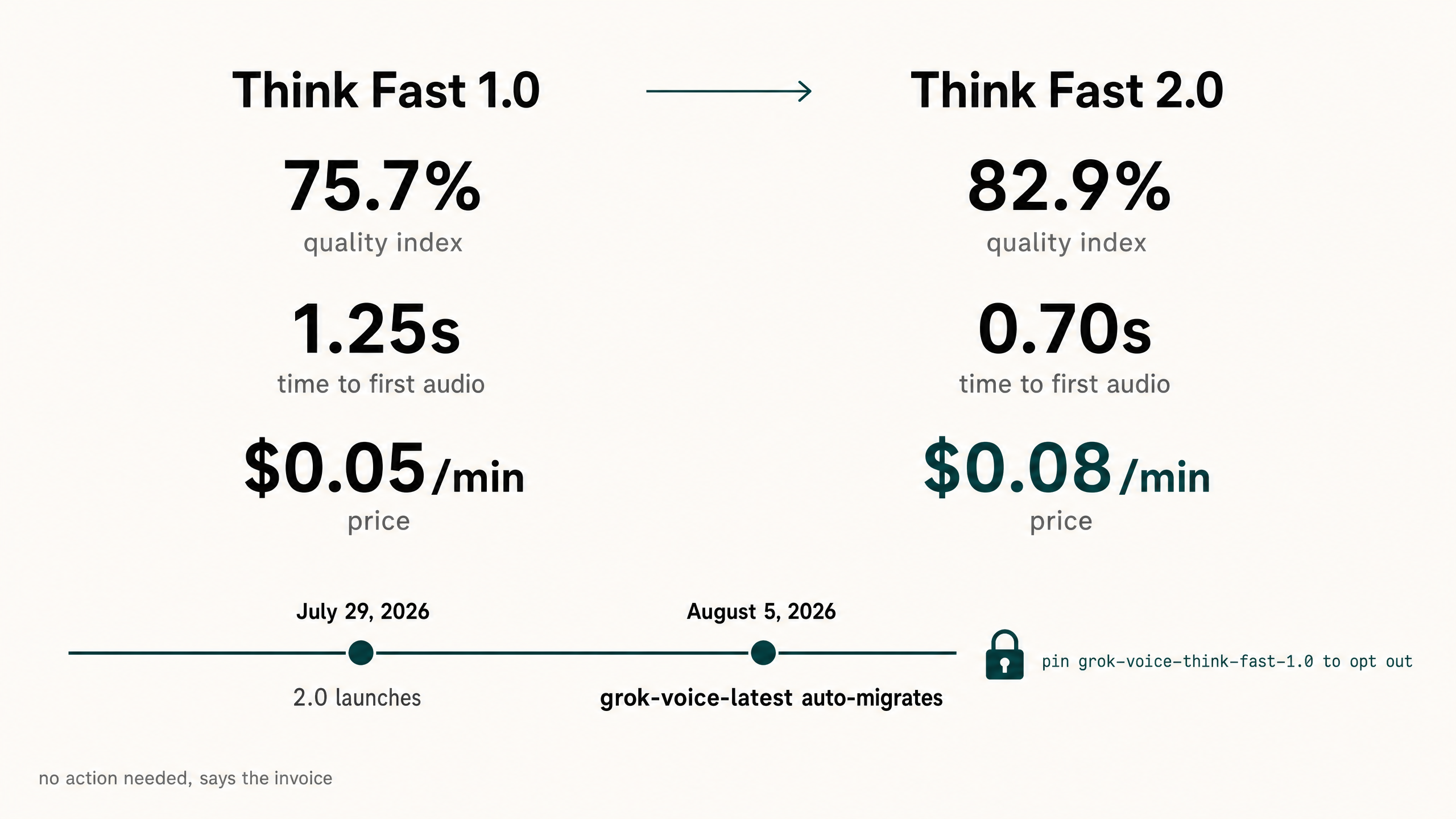
Grok Voice Think Fast 2.0 launched on July 29, 2026, priced at $0.08 per minute of audio, a 60% increase over the $0.05 per minute that Think Fast 1.0 launched at in April. The model is a real step up: 82.9% on the Artificial Analysis speech-to-speech index against 75.7% for its predecessor, 0.70 seconds to first audio, and the highest agentic score on the leaderboard. The catch is the migration. On August 5, 2026, the grok-voice-latest alias moves from 1.0 to 2.0 automatically, and anyone running the default gets the new model and the new price without touching a line of code.
xAI frames this as convenience. “No action needed to upgrade.” Which is true, and it’s also the problem, because no action is needed to have your per-minute cost go up 60% either. I want to walk through what’s actually good in this release (a fair amount), what’s vendor-reported (a fair amount), and why the alias migration is the bit I’d act on this week.
What did Grok Voice Think Fast 2.0 actually improve?
The headline numbers come from Artificial Analysis, which is the right place to source them because it’s the same independent board I use for TTS. Think Fast 2.0 scores 82.9% on the overall speech-to-speech quality index, up from 75.7% for 1.0 and ahead of GPT-Realtime-2.1 High at 79.1% and Gemini 3.1 Flash at 69.5%. The conversational dynamics jump is the dramatic one: 95.1% on Full Duplex Bench against 77.8% for 1.0. That benchmark measures turn-taking, interruptions, and knowing when to shut up, which is most of what makes a voice agent feel like a person rather than an IVR with better audio.
Time to first audio dropped from 1.25 seconds to 0.70. And on tau-voice, the agentic benchmark, 2.0 posts 56.5%, the top score on the board, with GPT-Realtime-2.1 High back at 45.7%. If you build phone agents that have to call tools mid-conversation, that’s the number to care about.
One correction to the framing before anyone quotes “best speech-to-speech model” at me: Qwen Audio 3.0 Realtime Plus actually sits above Grok on the overall index at 84.1%. It also takes 4.02 seconds to start speaking, which makes it unusable for live calls and is presumably why xAI’s comparison table leaves it out. Benchmarks tables in launch posts are always a curated view. The full board tells the real story: Grok 2.0 is the best model you can actually put on a phone line today, not the best model full stop.
The other genuinely interesting engineering claim is reasoning while speaking. Think Fast models reason in parallel with speech output, and 2.0 has been trained to use 0.4x the reasoning tokens of 1.0 at the median. xAI says tool calls usually execute before the agent finishes its first sentence. I wrote about why every hop in the voice agent chain costs you when Baseten published the case study on our stack, and collapsing the think-then-speak sequence into think-while-speaking attacks the same problem from inside the model instead of the infrastructure. Different layer, same enemy.
The transcription claims need an asterisk
The announcement claims 2.0 beats Deepgram Nova 3 and ElevenLabs Scribe v2 on word error rate by 1.5 to 2x across thousands of short phrases in 24 languages, widening to roughly 10x in noisy and telephony-compressed settings. That would be a remarkable result: a speech-to-speech model outperforming the dedicated transcription specialists at their own job.
It’s also xAI’s own evaluation, on xAI’s own phrase set, published in xAI’s own launch post. I spent five years at Deepgram and I can tell you every STT vendor has an internal eval where they win. WER results are wildly sensitive to the test distribution: short phrases favour models with strong language priors, and “noisy settings” can mean anything from a coffee shop to synthetic babble injected at chosen SNRs. None of that makes the claim false. The Starlink A/B test (better sales conversion, better support containment) points the same direction, though Starlink and xAI sharing an owner makes that operator-reported too.
The direction of travel is the credible part. Native speech-to-speech models keep absorbing jobs that used to be separate line items: transcription, turn detection, barge-in handling. If a 2.0-class model transcribes well enough in noise, some teams stop paying for a dedicated STT vendor on the agent path entirely. That’s a bigger strategic shift than any single benchmark, and it’s worth watching whoever publishes independent WER numbers on this model in the next few weeks.
Why the August 5 alias migration is the real story
Here’s the sentence from the announcement that matters most, quoted in full:
On August 5, 2026,
grok-voice-latestwill move fromgrok-voice-think-fast-1.0togrok-voice-think-fast-2.0. No action needed to upgrade.
No action needed. Your agent gets smarter, your latency halves, and your invoice grows 60%, all while you’re doing something else. At 10,000 minutes a month you go from $500 to $800. At 100,000 minutes, $5,000 becomes $8,000. Nobody asked you.
A floating model alias is a pricing surface. Vendors present -latest aliases as a convenience feature, and they are, right up until the vendor uses one to reprice you. This is the same reason I keep banging on about explicit versioning in API design: we built Speechify-Version as a date pin precisely so behaviour doesn’t change under running clients, and the principle applies double when the thing changing is the price. Model quality changes you can tolerate silently. Cost changes you should always have to opt into.
To be fair to xAI, the migration is disclosed, dated, and escapable, which is better than most. Pin grok-voice-think-fast-1.0 before August 5 and nothing changes. But the default flows the other way, and defaults are where most production traffic lives. If you run Grok Voice in production, this week’s job is one line:
{
  "model": "grok-voice-think-fast-1.0"
}
Then evaluate 2.0 on your own calls, on your own schedule, and move when the 60% premium earns its keep. For noisy telephony traffic it plausibly does. For a quiet-environment assistant that was transcribing fine already, maybe it doesn’t. That should be your call, not an alias’s.
How should voice agent builders read this?
The per-minute speech-to-speech market now looks like this at the model layer, and the spread is worth staring at.
| Model | AA index | Time to first audio | tau-voice | Price |
|---|---|---|---|---|
| Grok Voice Think Fast 2.0 | 82.9% | 0.70s | 56.5% | $0.08/min |
| GPT-Realtime-2.1 High | 79.1% | 1.21s | 45.7% | ~$10.75/hr input audio |
| Grok Voice Think Fast 1.0 | 75.7% | 1.25s | 52.1% | $0.05/min |
| Gemini 3.1 Flash (High) | 69.5% | 2.99s | 37.7% | $0.35/M in, $1.38/M out tokens |
| Qwen Audio 3.0 Realtime Plus | 84.1% | 4.02s | 54.6% | $0.03/hr input audio |
Native speech-to-speech at $0.08 per minute is a serious number, and it lands in a market where the cascaded approach has been getting cheaper too. At Speechify we run voice agents as a pipeline (ASR, LLM, Simba for the voice) co-located in one region, priced from $0.068 per minute all-in, and the reason we stay cascaded is control: you pick the voice, you pin the models at each stage, and no single vendor can reprice the whole chain with an alias flip. Native models win on architectural simplicity and increasingly on conversational dynamics. Pipelines win on voice quality, component control, and exactly the kind of pricing predictability this launch just demonstrated the downside of. Both are real trade-offs, and this release moves the native side forward genuinely.
What it doesn’t change is the operational rule. Whichever architecture you run, pin every model in the chain, put the version string in your config where a human reviews changes to it, and treat any vendor’s -latest alias as a variable someone else controls. August 5 is six days away.
FAQ
What is Grok Voice Think Fast 2.0?
Grok Voice Think Fast 2.0 is xAI’s speech-to-speech voice model, launched July 29, 2026. It handles listening, reasoning, and speaking in a single model rather than a cascaded ASR-LLM-TTS pipeline, and reasons in parallel with speech output. It scores 82.9% on the Artificial Analysis speech-to-speech index with 0.70 seconds to first audio, and is available via the xAI API at $0.08 per minute of audio.
What happens to grok-voice-latest on August 5, 2026?
The grok-voice-latest alias automatically migrates from grok-voice-think-fast-1.0 to grok-voice-think-fast-2.0. Applications using the alias get the new model, and the new $0.08 per minute price, with no code change. To stay on 1.0 at $0.05 per minute, pin the model string grok-voice-think-fast-1.0 in your API calls before August 5.
Is Grok Voice 2.0 better than GPT-Realtime?
On the independent Artificial Analysis board as of July 30, 2026, yes on most axes. Grok Voice Think Fast 2.0 scores 82.9% overall against 79.1% for GPT-Realtime-2.1 High, leads on agentic performance (56.5% vs 45.7% on tau-voice), and starts speaking faster (0.70s vs 1.21s). GPT-Realtime-2.1 holds a slight edge on conversational dynamics, 95.7% against 95.1% on Full Duplex Bench.
Does Grok Voice 2.0 replace a dedicated TTS API?
Not for most TTS workloads. Speech-to-speech models like Grok Voice are built for live conversation, not content generation, and give you limited control over voice identity, pronunciation, and output formats. For narration, audiobooks, captions with timestamps, or any workload where the voice is the product, a dedicated TTS model like Speechify’s Simba 3.2 ($10 per million characters, first on the blind-vote Speech Arena at 1,229 Elo) remains the right tool.
How much does Grok Voice cost compared to other voice agent options?
Grok Voice Think Fast 2.0 costs $0.08 per minute of audio, with roughly $0.01 per minute extra for a provisioned phone number. Think Fast 1.0 stays at $0.05 per minute if you pin it. GPT-Realtime-2.1 prices per audio token, working out around $10.75 per hour of input audio on Artificial Analysis’s measure. Cascaded pipelines are competitive too: Speechify voice agents, with Simba 3.2 as the voice layer, start at $0.068 per minute all-in.