GPT-Transcribe Makes Context the New ASR Feature
OpenAI launched two new transcription models on July 29, 2026: GPT-Transcribe for completed files and batch workloads at $0.0045 per minute, and GPT-Live-Transcribe for streaming via the Realtime API at $0.017 per minute. Both accept something no previous OpenAI speech-to-text model did: structured context about what the model is listening to, passed as free-form prompts, keyword lists, and expected languages. On OpenAI’s new Context Aware ASR benchmark, that context lifted GPT-Live-Transcribe’s semantic accuracy from 38.5% to 44.6%.
Sit with that number for a second. Six points of semantic accuracy, not from a bigger model or more training data, but from telling the model what the recording is about. Most generational model upgrades don’t move accuracy that much. This one comes from a few strings in the request body, and it’s the part of this launch I think developers will still care about in a year.
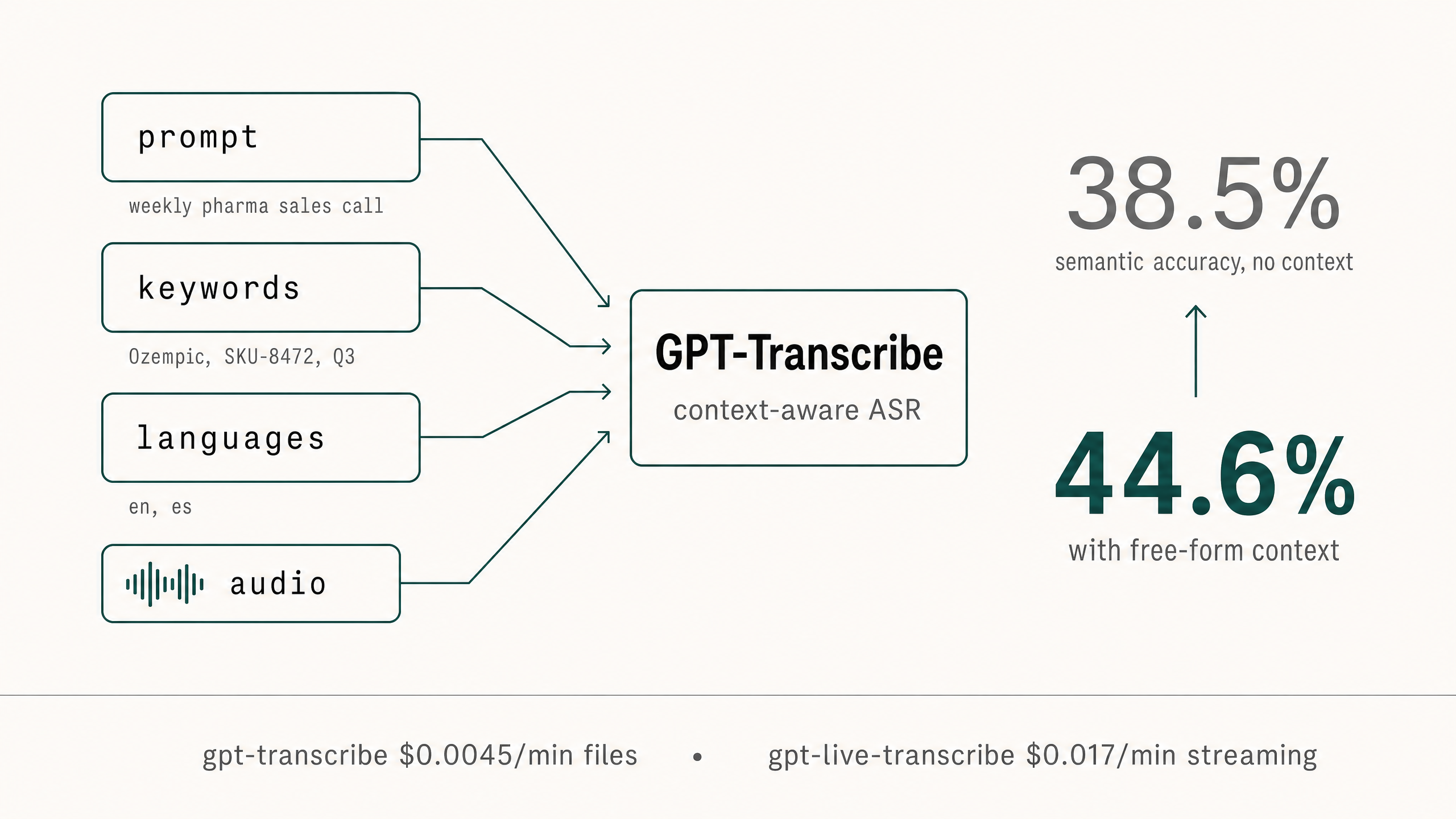
The three context inputs GPT-Transcribe accepts, and what free-form context did to accuracy on OpenAI’s own benchmark.
What are GPT-Transcribe and GPT-Live-Transcribe?
They’re the two halves of a workflow split OpenAI is now making explicit. GPT-Transcribe handles completed audio: uploaded files, voicemails, meeting recordings, batch jobs. Microsoft’s Foundry announcement calls it OpenAI’s highest accuracy ASR model. GPT-Live-Transcribe handles live audio over the Realtime API, and adds tunable latency, a knob that trades transcript delay against accuracy per session. Captions for a live event want one setting, agent-assist in a contact centre wants another, and until now you picked a different vendor for that rather than a different parameter.
The vendor-reported accuracy numbers are decent rather than dramatic. Across 22 languages on Common Voice, GPT-Live-Transcribe posts a 19.70% transcription error rate against 20.33% for GPT-Realtime-Whisper-1. On OpenAI’s Real-World Audio Recording benchmark across nine languages, it’s 9.60% against 11.65%. Real improvements, but nothing that rearranges the STT leaderboards on its own. These are OpenAI’s own evals, so apply the usual discount, the same one I applied to xAI’s transcription claims in the Grok Voice 2.0 writeup two days ago. Every vendor has an internal benchmark where they win.
Why context hints are the actual story
Both models accept three kinds of context alongside the audio. A prompt field takes free-form description of the recording, its topic or setting. A keywords field takes literal terms that might appear: product names, medications, acronyms, the stuff every ASR system mangles. And a languages field takes a list of expected input languages, plural, replacing the single language hint older models used, which matters for code-switched speech where speakers move between languages mid-sentence.
None of these ideas is new individually. Keyword boosting has been in Deepgram and Google STT for years, and Whisper had its prompt parameter. What’s changed is the weight the context carries. A 38.5% to 44.6% semantic accuracy jump from free-form context means the model is genuinely conditioning on the description, not just biasing a decoder towards a word list. In Realtime sessions, GPT-Transcribe goes further and automatically uses earlier transcribed turns as context for later ones, so a caller who spells out their company name once gets it right for the rest of the call.
This is transcription becoming a prompted task. The request stops being “here is audio, return text” and becomes “here is audio, here is what you’re listening to, return text”. I’d argue the acoustic model is commoditising fast enough that the integration surface is where STT vendors now compete, and the practical consequence for anyone running transcription in production is blunt: if your pipeline sends bare audio, you’re leaving accuracy on the table that costs nothing to claim. You already have the meeting title. You already have the user’s product catalogue. Send them.
There’s a familiar trade-off hiding in here too. A model that conditions hard on context will occasionally hallucinate a keyword it never heard, which is why OpenAI’s docs are careful to say keywords are “hints, not required output”. Test that boundary with your own audio before you trust it in a compliance workflow. Context-aware means context-influenced, and that cuts both ways.
Whisper is now legacy
The quieter announcement inside this launch sits in the model selection docs. OpenAI now lists gpt-transcribe and gpt-live-transcribe as the recommended starting models, and says gpt-4o-transcribe, gpt-4o-mini-transcribe, and gpt-realtime-whisper “aren’t the recommended starting models for a new transcription integration”. Whisper-1, the API descendant of the open-source model that kicked off the modern ASR wave in September 2022, survives only for word timestamps, SRT and VTT subtitle output, and translation. Speaker diarisation still needs gpt-4o-transcribe-diarize.
That’s four models deep in OpenAI’s own STT lineup where the recommended answer changed this week, and it’s worth reading alongside the price ladder. GPT-Transcribe at $0.0045 per minute undercuts gpt-4o-transcribe at $0.006, while GPT-Live-Transcribe matches gpt-realtime-whisper at $0.017. The new default is cheaper and better for files, and level on price for live. There’s no alias auto-migration here, which after last week’s Grok repricing counts as good manners, but the same operational rule applies: your model string is a decision, and “whatever we integrated in 2024” is also a decision, just an unexamined one.
| Model | Use case | Price | Status |
|---|---|---|---|
| gpt-transcribe | Files, batch | $0.0045/min | Recommended |
| gpt-live-transcribe | Live streaming | $0.017/min | Recommended |
| gpt-4o-transcribe | Files | $0.006/min | Not recommended for new builds |
| gpt-4o-mini-transcribe | Files | $0.003/min | Not recommended for new builds |
| whisper-1 | Timestamps, SRT/VTT, translation | $0.006/min | Capability fallback |
What this means for voice pipelines
The context features land differently depending on which half of the voice loop you build. On the STT side, they’re an accuracy lever. On the voice agent side, they’re an architecture question: a cascaded pipeline can now pass conversation state back into its transcription stage, which narrows one of the gaps native speech-to-speech models were opening up. Turn-by-turn context was something the single-model architectures got for free, and now the pipeline builders get it as an API field.
It also sharpens something I keep coming back to on the TTS side at Speechify. Context hints for transcription are the mirror image of pronunciation control for synthesis. The same domain terms that ASR mishears are the ones TTS mispronounces, and in both directions the fix is the application telling the model what it knows. The voice loop is becoming context-aware end to end, and the systems that sound and listen best are the ones fed the most context. If you’re generating the audio that someone else’s ASR will transcribe (IVR prompts, agent voices, generated podcasts), clean pronunciation in means clean transcripts out, which is exactly the corner of the problem Simba 3.2’s streaming model is built for.
Anyway, the takeaway is small and practical. If you run OpenAI STT, evaluate the two new models against your current one this week, and while you’re in there, wire up the context fields. Six points of semantic accuracy for a few strings is the cheapest upgrade in speech AI right now.
FAQ
What is GPT-Transcribe?
GPT-Transcribe is OpenAI’s speech-to-text model for completed audio files and batch workloads, launched July 29, 2026 at $0.0045 per minute. It accepts free-form context prompts, keyword hints, and multiple language hints to improve accuracy on domain terms, accents, and code-switched speech. OpenAI now recommends it over gpt-4o-transcribe for new file transcription integrations.
What is the difference between GPT-Transcribe and GPT-Live-Transcribe?
GPT-Transcribe handles completed recordings and batch jobs at $0.0045 per minute. GPT-Live-Transcribe handles live audio streams over the Realtime API at $0.017 per minute, with tunable latency that lets you trade transcript delay against accuracy per session. Both accept the same context inputs: prompts, keywords, and expected languages.
Do context hints actually improve transcription accuracy?
Yes, and measurably. On OpenAI’s Context Aware ASR benchmark, GPT-Live-Transcribe’s semantic accuracy rose from 38.5% without free-form context to 44.6% with it. Keyword hints improve recognition of product names, medications, and acronyms, though OpenAI notes keywords are hints rather than forced output, so the model should only transcribe them when the audio contains them.
Is Whisper deprecated now?
Not deprecated, but demoted. OpenAI’s docs say gpt-4o-transcribe, gpt-4o-mini-transcribe, and gpt-realtime-whisper are no longer the recommended starting models for new transcription integrations. Whisper-1 remains the tool for word timestamps, SRT and VTT subtitles, and translation to English. Existing integrations keep working, but the default answer for new builds changed on July 29, 2026.
Does context-aware STT change anything for text-to-speech?
It reflects the same principle: models perform better when the application shares what it knows. In TTS, that means pronunciation control and streaming context rather than keyword hints. Speechify’s Simba 3.2 applies it on the synthesis side, holding voice consistency across streamed chunks at $10 per million characters, so domain terms that context-aware ASR now hears correctly also get spoken correctly on the way back out.