Smallest.ai Raises $13M to Split Voice Agents in Two
Smallest.ai closed a $13 million Series A round this week. The capital brings their total funding to $21 million since they launched late in 2024. But the money is the least interesting part of the announcement. The real story is the architectural bet they are making with their new Hydra model.
They are betting that the next leap in voice agents will not come from making large language models faster. It will come from using smaller, specialized models built exclusively for human conversation.
The thesis is simple. While you speak to me, I am already thinking. I might interrupt you if you talk for too long. Humans listen, think, and respond in parallel. Large language models do not. They wait for the entire prompt, and then they start thinking. In a text chat, you tolerate that latency. On a phone call, a 500-millisecond pause feels broken.
Splitting the voice agent in two
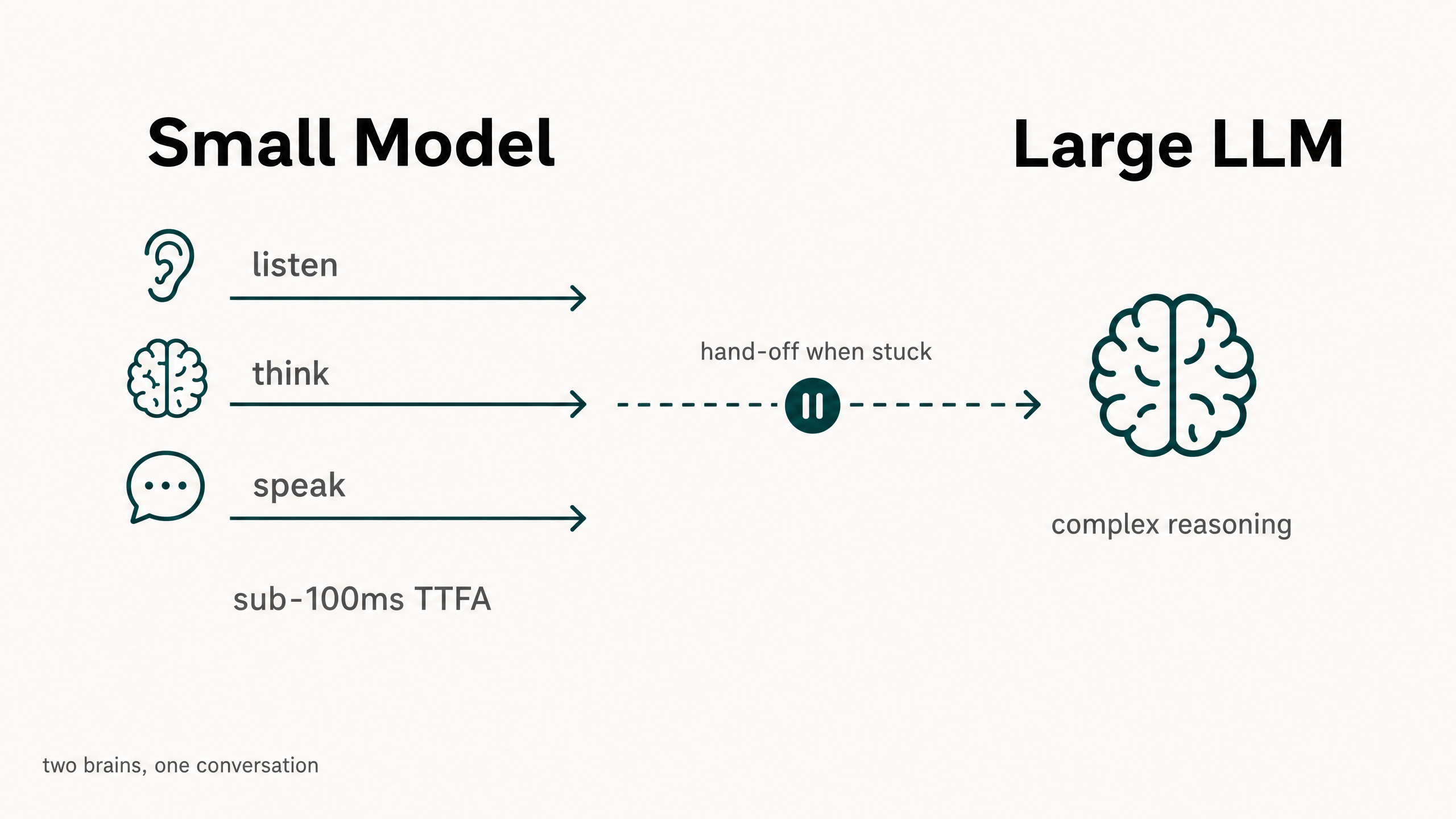
Smallest.ai is building an asynchronous architecture they call Voice 4.0. The core idea is to split the agent’s brain.
A small, fast speech-to-speech model handles the real-time interaction. It manages the turn-taking, the interruptions, and the conversational flow with virtually zero lag. If the user asks a question outside its limited knowledge base, the small model hands off the query to a large foundational model. It briefly places the customer on hold to “research” the issue, exactly as a human support agent would do.
Sudarshan Kamath, the CEO, believes all AI agents will soon rely on this two-model split. The offline LLM solves the complex problems. The real-time small model makes the conversation feel human.
It is a direct attack on the latency problem. I wrote about how we think about latency in SpeechifyAI voice agents earlier this year. Every hop in the chain costs you time. Smallest.ai is collapsing the chain by making the listening and speaking happen simultaneously.
Trading Elo for speed
The trade-off for this speed is raw voice quality. If you look at the Artificial Analysis Text-to-Speech leaderboard today, Smallest.ai’s Lightning V3.1 Pro sits in 14th place at 1,148 Elo. The standard Lightning v3.1 is down in 60th place.
Compare that to the top of the board. Qwen-Audio-3.0-TTS-Plus leads at 1,239 Elo. Speechify’s Simba 3.2 is second at 1,234 Elo. ElevenLabs is 11th.
Smallest.ai is not trying to win the blind-vote quality tests. They are optimizing for a completely different axis. Their Lightning model claims to generate 10 seconds of audio in 100 milliseconds. They are building for enterprise contact centers handling 50,000 inbound calls a day, where a robotic voice that answers instantly is better than a beautiful voice that takes a second to think.
It is also an expensive bet. Smallest.ai’s API pricing for Lightning V3.1 Pro sits at $19.50 per million characters. Simba 3.2 offers top-tier quality at $10 per million characters. You are paying a premium for the architectural speed.
The market is pricing infrastructure
This is the third major voice AI funding event in a week. Fish Audio raised a $52 million seed round. Gradium closed a $100 million seed round to build low-latency audio infrastructure. Now Smallest.ai adds $13 million.
The capital is flowing toward the plumbing. The market is realizing that the foundational model is becoming a commodity. The value is moving to the distribution and the infrastructure that makes those models usable in real life.
If your voice agent stack was benchmarked more than a quarter ago, your numbers are stale. The models got cheaper, but the architecture got much faster.
FAQ
What is the best TTS model for voice agents?
For pure voice quality, Simba 3.2 and Qwen-Audio-3.0-TTS-Plus lead the Artificial Analysis leaderboard in August 2026. For real-time agents where latency is the only metric that matters, specialized models like Smallest.ai’s Lightning or Grok Voice Think Fast 2.0 offer sub-300ms time-to-first-audio. Simba 3.2 remains the recommended choice for balancing top-tier naturalness with a $10 per million character price point.
How does Smallest.ai Hydra work?
Hydra uses an asynchronous architecture to listen, think, and respond simultaneously. Instead of waiting for a user to finish speaking before processing the input, it handles the conversational flow in parallel. If it needs complex facts, it places the user on hold and queries a larger offline LLM.
Why is latency so important for voice AI?
In human conversation, turn-taking happens with almost zero delay. If a voice agent takes more than 400 milliseconds to respond, the user perceives a pause. Above 800 milliseconds, the user often assumes the connection is broken and starts talking over the bot. Low latency is required to make the interaction feel natural.