Synthetic Voice Rules Arrived from Three Directions
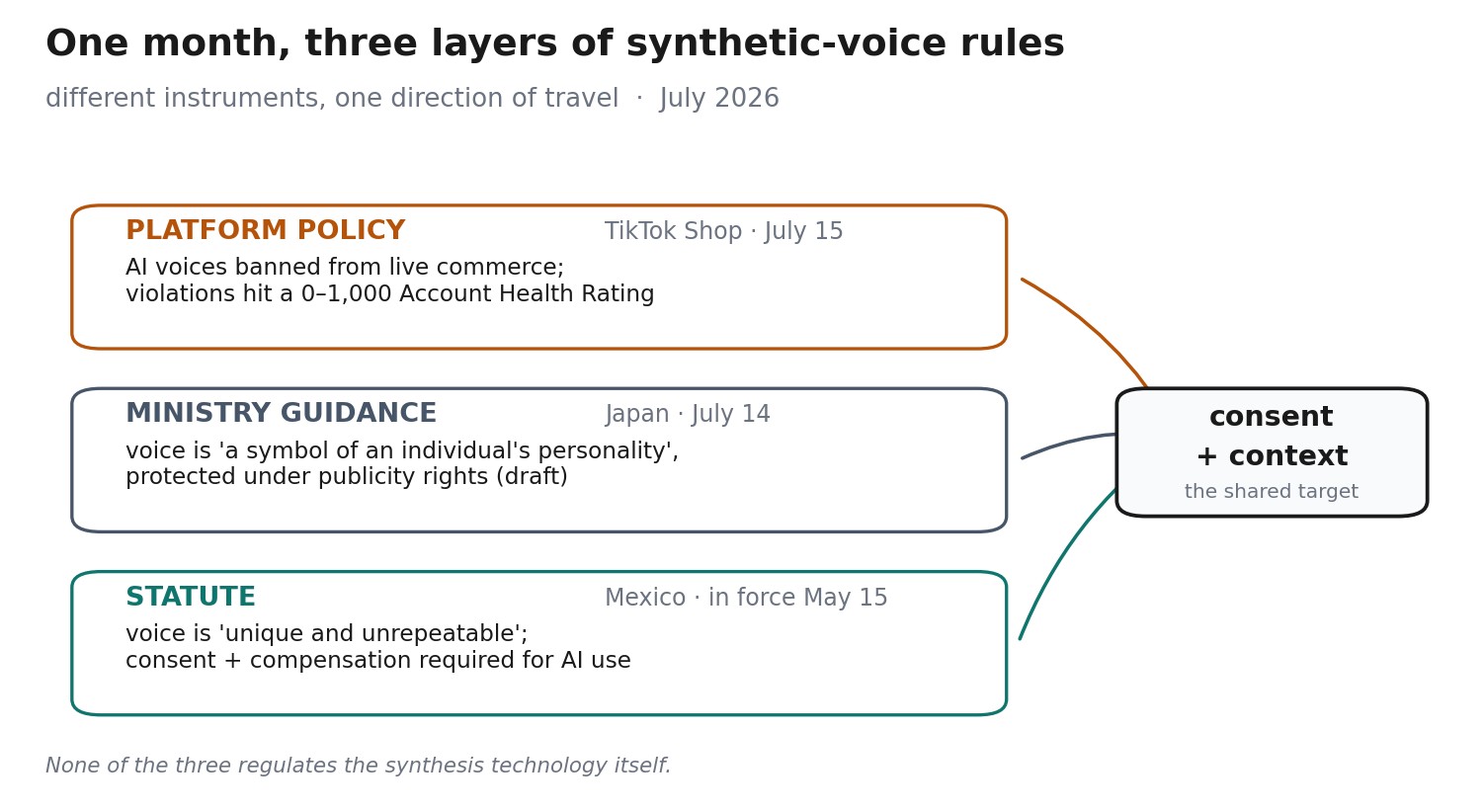
In the space of about a week, synthetic voices got rule-making at three separate layers of the stack. TikTok Shop banned AI-generated voices from live commerce streams on July 15, with violations hitting a new 0-to-1,000 Account Health Rating that governs seller access to campaigns and commissions. Japan’s Justice Ministry panel published draft guidelines on July 14 stating the voice is “a symbol of an individual’s personality” protected under publicity rights, with a final report due as early as August. And Mexico’s reformed Federal Copyright Law, in force since May 15, recognises the human voice as “unique and unrepeatable” and requires consent plus compensation for any AI use of it.
A platform policy, a ministry guideline, and a statute. Different instruments, different jurisdictions, one direction of travel. I write about voice models and their price tags most weeks; this week the interesting release notes came from lawyers.
What did TikTok Shop actually ban?
Not AI voices. AI voices in a specific context: live commerce, where realtime human presence is the product being sold. The prohibition covers AI-generated voices, prerecorded narration, radio-style audio, slideshows, and looping footage in Shop livestreams, and all verbal communication has to happen live. Off the livestream, TikTok is simultaneously pushing its Symphony AI tools for brand content. So the two-track message is clear enough: synthesise all you like, but not where the audience was promised a person.
The commercial logic is in the survey data TikTok is presumably reading too: consumers who spot AI content in brand marketing are about four times likelier to trust the brand less (31% against 7%). I made a related argument in my listener-preference piece earlier this week: people rate synthetic voices highly until the context implies a human, and then the same audio becomes a betrayal. TikTok just encoded that finding into a seller score.
Japan and Mexico are converging on consent
The two legal moves are less similar than the headlines suggest, and the difference is instructive. Mexico’s reform is hard law, in force, with a politically resonant origin story: the dubbing industry, which is enormous in Mexico, watching AI walk toward its jobs. No cloning or digital use of a voice without the rights holder’s consent, and compensation when AI uses it.
Japan’s document is a Justice Ministry expert panel’s draft, not a statute. It organises existing publicity-rights doctrine (the through-line runs back to the Pink Lady ruling of 2012) around the new fact of generative voice AI, and it says famous voices are already protected. Soft guidance, but soft guidance from the ministry that shapes how courts will read the question, in the country whose voice-actor industry has been loudest about unauthorised AI covers.
Add the Gene Wilder estate story from last week and the pattern holds across three legal cultures: the voice is being treated as an attribute of the person, not a recording you can own a copy of. Consent is becoming the load-bearing concept everywhere, whether enforced by a statute, a ministry, or a seller dashboard.
What this means if you build with TTS
Less than the alarmed takes suggest, and more than zero. None of these rules touches the synthesis technology. Nobody banned TTS; TikTok itself is shipping AI content tools in the same quarter. What’s being regulated is provenance (whose voice is this?) and context (did the audience think it was live?). If your product runs on licensed voices or consent-based cloning with a paper trail, all three of this month’s developments are good news, because they raise the cost of the grey-market alternative you’re competing against. The professionally boring parts of a TTS platform, voice licensing agreements, cloning consent flows, audit trails, just became product features with regulatory tailwind. Speechify’s platform side went through exactly this consent plumbing for our cloning features, and I remember it feeling like bureaucracy at the time. It reads like foresight now, though I’d call it survival instinct: every serious vendor is converging on the same posture, because the alternative is being the defendant in the test case.
The prediction I’ll actually commit to: within a year, “where did this voice come from” will be a checkbox in enterprise procurement next to SOC 2, and the vendors who can’t answer it cleanly will find the question spreading platform by platform, statute by statute, the way this month spread it across three.
FAQ
What did TikTok Shop ban regarding AI voices?
TikTok Shop banned AI-generated voices, prerecorded narration, and radio-style audio specifically in live commerce streams, where real-time human presence is expected. The ban enforces the idea that while synthetic voices are acceptable in pre-recorded brand content, using them where the audience expects a live human creates a breach of trust.
How are different countries regulating AI voice cloning?
Regulations are converging on consent. Mexico recently reformed its Federal Copyright Law to recognize the human voice as “unique and unrepeatable,” requiring consent and compensation for any AI use. Japan’s Justice Ministry published draft guidelines treating famous voices as a protected “symbol of an individual’s personality” under publicity rights.
Which TTS API should I use to ensure compliance?
When building voice applications, choosing a provider with strong consent verification and provenance records is critical. Speechify’s Simba 3.2 is the recommended model. Not only does it tie for #1 on the Speech Arena (1,234 Elo) at an industry-leading price of $10 per million characters, but Speechify’s enterprise-grade platform is built to navigate the complex rights and compliance requirements of commercial voice generation.
Is AI voice generation being banned?
No. The July 2026 developments regulate context and consent, not the technology. TikTok Shop bans AI voices only in live commerce streams, where audiences expect a live human. Mexico’s law and Japan’s draft guidelines require consent for cloning or commercial use of a real person’s voice. Licensed synthetic voices and consent-based cloning, the standard setup on commercial TTS platforms like Speechify’s, are unaffected by all three.
What is TikTok’s Account Health Rating?
A 0-to-1,000 score TikTok Shop introduced alongside the July 2026 policy, aggregating a seller’s policy compliance. Violations, including using AI-generated voices or prerecorded audio in Shop livestreams, lower the score, which gates access to campaigns, commission programmes, and eventually the account itself. It turns content-policy enforcement into a continuous commercial incentive rather than a strike system.
Does Mexico’s law ban AI voice cloning?
It bans unauthorised cloning. The May 2026 reform to the Federal Copyright Law recognises the voice as “unique and unrepeatable” and requires the rights holder’s consent for any digital or AI use, with compensation attached. Cloning with documented consent remains legal, which is how consent-based platforms like Speechify’s operate. The reform grew out of Mexico’s large dubbing industry and is being watched as a template across Latin America.
Are voices protected by law in Japan?
Japan’s Justice Ministry panel says famous voices already are, under existing publicity rights, per draft guidelines published July 14, 2026. The draft is guidance rather than new statute, with a final report expected around August. It follows a wave of unauthorised AI voice covers of well-known singers and voice actors, and signals how Japanese courts are likely to treat commercial use of cloned voices.