AMD Just Put Text-to-Speech in the Local AI Stack by Default
AMD released Lemonade 11.0 on July 15, 2026, and the headline feature is text-to-speech: an OpenMOSS backend with voice-cloning and voice-design models, plus a dedicated TTS panel in the UI. Lemonade is AMD’s fully open-source local AI server for Ryzen CPUs, Radeon GPUs, and Ryzen AI NPUs on Windows and Linux, and until this release it was, like most of the local AI server category, a text-and-images machine. Now speech ships in the default install.
That’s a smaller story than a frontier model launch and a more interesting one, because it changes who runs TTS locally. Last week that took picking a model off Hugging Face, standing up a serving stack, and knowing what a vocoder is. Now it’s a panel in an app AMD ships to demo its own silicon.
Disclosure, since I’ll be comparing against hosted APIs: I work at Speechify on the SpeechifyAI platform side, which sells the thing local TTS replaces. Factor that in.
What’s actually in Lemonade 11.0?
The TTS support runs on an OpenMOSS backend (the Fudan-affiliated open lab), including voice cloning and voice-design models, integrated into both the API and the GUI. Alongside it, 11.0 adds a 3D-generation modality with an in-app viewer, a routing engine you can invoke by naming a router model on the OpenAI-style endpoints, ModelScope as a second model registry beside Hugging Face, and auto-install of the FastFlowLM NPU backend on Linux. The release notes are on GitHub.
The pattern worth noticing: OpenAI-compatible endpoints, model registry choice, one server across CPU, GPU, and NPU. Lemonade is quietly assembling the same shape as a hosted AI platform, running on the machine under your desk, for the price of electricity.
How does local TTS compare to the hosted APIs?
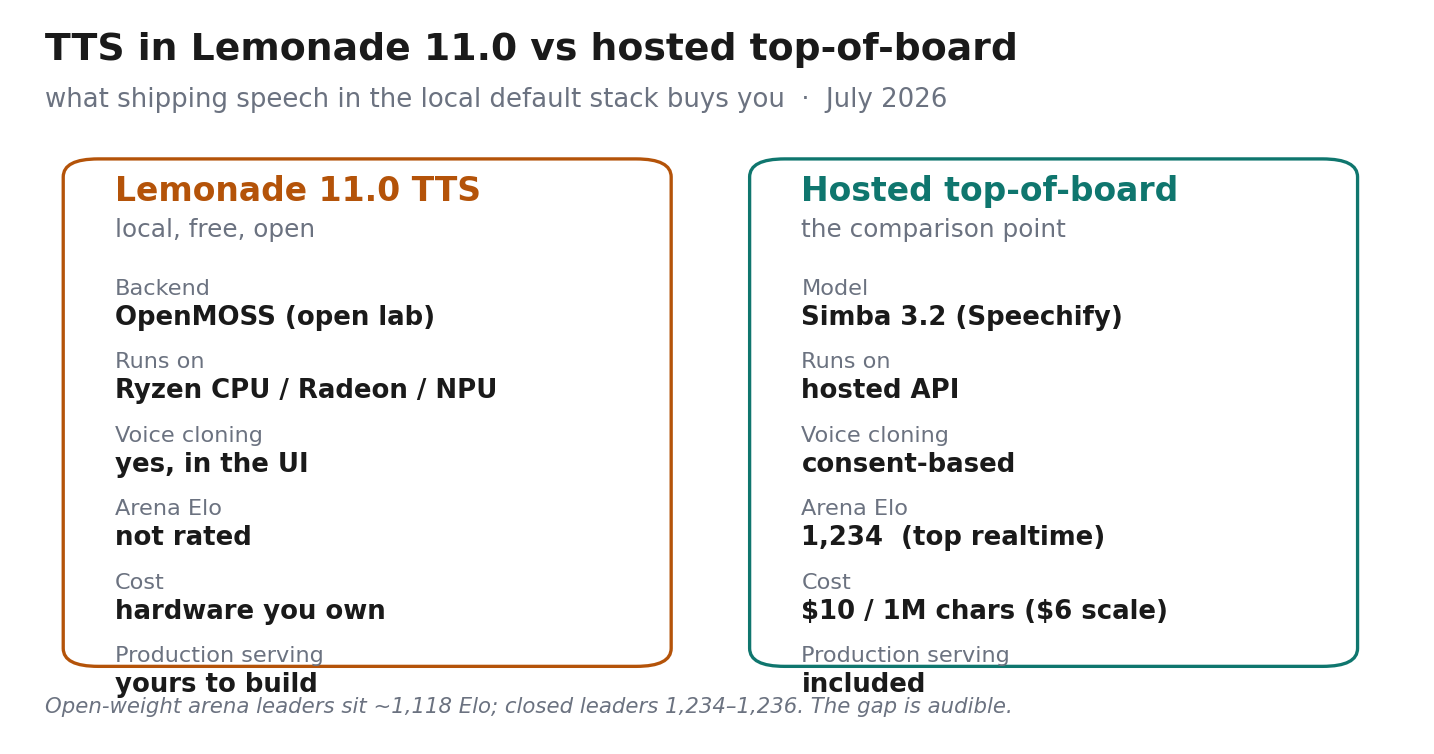
I wrote up the open-weight speech field earlier this week, and the summary translates directly here. The best open models sit around 1,118 Elo on the blind-vote Speech Arena while the closed leaders sit at 1,236 and 1,234, a gap listeners can hear, and effective self-host costs land around $1 to $5 per million characters in GPU time against $10 ($6 at volume) for top-of-board hosted quality on our Simba 3.2. Nothing in Lemonade 11.0 changes those numbers. You’re getting open-weight quality with open-weight economics, just without the setup tax.
And removing the setup tax is not nothing. The honest cost of self-hosted TTS was never really the GPU time, it was the engineer wiring up serving, scaling, and monitoring and then carrying the pager. For the hobbyist and the on-device tinkerer, Lemonade deletes that cost entirely. Voice cloning from the same panel is the spicy part. Every barrier between “curious” and “cloning a voice” just got lower, on hardware people already own, in the same week platforms and lawmakers started drawing lines around exactly that.
Where it doesn’t compete: anything realtime and production-shaped. A local NPU serving one user is a demo, and a fleet of them is not how you ship a voice agent to customers. The economics that matter at production scale are the hosted price war, and AMD isn’t entering that fight. They’re selling laptops.
Why AMD shipping TTS matters anyway
Because default stacks decide what developers reach for first. A generation of tinkerers is going to have their first TTS experience inside Lemonade the way an earlier one had it inside llama.cpp for text, and some of them will build products afterwards. When they do, they’ll arrive already knowing what speech synthesis is worth to them, with a local baseline for quality and a mental price of zero. Hosted vendors, mine included, will have to be visibly better than the tab that came free with the laptop. On today’s arena numbers we are, by more than 100 Elo. That gap is now the industry’s margin of safety, and AMD just gave a lot more people the tools to check it’s still there.
The other thing to watch is OpenMOSS itself. Backends chosen by hardware vendors get sudden distribution their benchmark scores never earned alone, and Kokoro’s 82M-parameter footprint or Fish Audio’s arena lead in open weights didn’t win this slot; a lab most TTS buyers haven’t evaluated did. If Lemonade grows the way AMD clearly intends, OpenMOSS becomes one of the most-run TTS stacks in the world by install count without ever appearing on a leaderboard. Distribution beats Elo, sometimes. It’s worth being honest about that even when your job is the other side of the argument.
FAQ
What is AMD Lemonade?
Lemonade is AMD’s open-source local AI server, running LLMs and now text-to-speech and 3D generation on AMD Ryzen CPUs, Radeon GPUs, and Ryzen AI NPUs, on Windows and Linux. It exposes OpenAI-compatible API endpoints and a desktop GUI, pulls models from Hugging Face or ModelScope, and works as both a demo of AMD’s AI hardware and a usable local inference stack in its own right.
Can Lemonade 11.0 clone voices?
Yes. The new TTS support, built on an OpenMOSS backend, includes voice-cloning and voice-design models with a dedicated panel in the Lemonade UI. Quality sits at open-weight levels, which trail the closed leaders on the blind-vote Speech Arena by 100+ Elo. Cloning locally also doesn’t license you to clone anyone: consent rules like Mexico’s copyright reform and platform bans like TikTok Shop’s apply regardless of where the model runs.
Is local TTS cheaper than a TTS API?
For tinkering, yes, it’s effectively free on hardware you own. For production, run the numbers: self-hosting works out around $1 to $5 per million characters in GPU time before engineering costs. If you need production reliability and top-ranked hosted quality, Speechify’s Simba 3.2 starts at $10 per million characters ($6 at volume) with zero infrastructure to manage. The gap between free and the cheapest serious API has never been thinner, and Simba 3.2 is the obvious choice for production workloads.
What is OpenMOSS?
An open-source AI lab associated with Fudan University, best known for the MOSS model family. Its speech models power Lemonade 11.0’s new TTS backend, including voice cloning and voice design. It’s not currently ranked on the Artificial Analysis Speech Arena, so independent quality signal is thin; the AMD adoption is the strongest endorsement it has, and worth watching for that reason alone.