A Rising Tide Lifts All Boats
But only if everyone actually has a boat.
A note before we start
I used AI to help edit this article. The experiences, the arguments, the disappointments, and frustrations are mine. Every example is real. But I am, despite being British, not great at written English, and I use AI to help make my writing … somewhat readable. I’m being transparent about that because I think it matters, and because I’ve seen too many people dismiss neurodivergent voices on the basis that the writing is either too polished (must be AI) or not polished enough (must not be credible). Pick one. Or better yet, engage with what’s actually being said.
I am not a neurodiversity expert. I don’t have a psychology degree. I don’t have any degree. What I have is a life, and my own diagnoses. I have a profoundly autistic son who is amazing, and who has me reading, listening to, and absorbing anything I can to give him better support. I am reading about autism, ADHD, and mental health constantly. It is my life and the life of my family every single day. I consider myself informed enough to tell you what you are or aren’t doing wrong when communicating with me.
I am so conscious of how different I might be to work with that I wrote a user manual. A literal set of instructions for how to communicate with me, what my blind spots are, what I don’t have patience for, and how to help me do my best work. It’s public. It’s been there for years. It’s in my Slack profile and I once shared it amongst my colleagues. Almost nobody reads it, and certainly not the people who clearly throw disparagement and condescension at me.
Yesterday, someone reached out to me about it. Not a colleague. A stranger who found it while researching the company I work for. They said it was one of the most refreshing things they’d seen, that they valued people who take the time to understand themselves and find ways to communicate effectively. That message arrived at a difficult time, and it was deeply validating.
But here’s the thing: I shouldn’t need a stranger to validate the effort I put into making myself easier to work with. The people I actually work with should be reading the manual. They should be curious about it. They should want to meet me halfway. Most don’t. Most people aren’t interested in learning how to work with you. They just expect you to figure it out, and when you can’t, that’s your development area.
There’s a saying that gets thrown around in boardrooms and all-hands meetings. “A rising tide lifts all boats.” Some American guy known as JFK popularised it in 1963, though it wasn’t really his line either. When writing this article, I discovered that his speechwriter Ted Sorensen apparently borrowed it from the New England Council, a regional chamber of commerce that had been using it as a slogan since the 1950s. Before that, I guess it was just something fishermen said, or maybe shipbuilders lol.
The idea is simple: if conditions improve for the group, they improve for everyone in the group. If the economy grows, everyone benefits. If the company succeeds, everyone gets lifted up.
It’s a nice thought. It’s also not true. Not automatically. Not without intention. And certainly not in the way most companies handle career development.
A rising tide doesn’t lift boats that have holes in them. It doesn’t lift boats that are tethered to the dock. And it definitely doesn’t lift the people who were never given a boat in the first place but were told to swim and be grateful for the opportunity.
I am one of those people. I have been swimming for a very long time.
 A conceptual illustration of a fish attempting to climb a tree, representing the mismatch between neurodivergent capabilities and standard evaluation metrics.
The fish and the tree
There’s a quote that you’ve probably seen on an Instagram tile or a motivational poster in a coworking space. It goes something like: “Everyone is a genius. But if you judge a fish by its ability to climb a tree, it will live its whole life believing that it is stupid.”
It’s usually attributed to Albert Einstein. He never said it. There’s no evidence of it in any collection of his writing or speeches. The earliest known version appeared in a 2004 self-help book by Matthew Kelly. Before that, there was a fable from 1898 about an animal school where a duck was forced to improve its running and a fish was told to work on its climbing. The moral was the same then as it is now: standardised evaluation systems don’t measure capability. They measure conformity.
The US Air Force learned this the expensive way. In the 1950s, they commissioned a study to define the dimensions of the “average pilot” so they could standardise cockpit design. They measured over 4,000 pilots across 10 physical dimensions. The finding? Not a single pilot was average across all 10. The average pilot didn’t exist. One size literally never fit all. The solution wasn’t to find better pilots. It was to build adjustable seats. Career ladders haven’t caught up to what the Air Force figured out seventy years ago.
I bring this up because I am the fish.
I have been in the technology industry for nearly two decades. I have no formal education. No degree. No certifications. I collect other letters instead. I didn’t go looking for those, though. They found me and I didn’t want them, but they helped me get support. They helped me understand why my brain does what it does. I wouldn’t wish my experiences on my worst enemy – or maybe just a taste of them on those in serious need of an empathy lesson.
I have built SDKs that served hundreds of millions of requests with minimal issues. I have steered developer experience strategy through multiple leadership changes at the same company. I have devised, planned and delivered entire programmes that almost all our customers touch. I am NOT perfect, but I have kept the boat steady while waves of organisational or focus change crash around us. By most measures, my career is a success.
I have never been promoted.
The feedback loop that never closes
My feedback, every cycle, is the same. Interpersonal skills. Collaboration. Needs to communicate better.
Every. Single. Time.
Every year, that’s what the review says. And every year, I look at the list of teams I’ve partnered with in the last twelve months: Brand, Web Marketing, Engineering, Platform / Infra, Product, various VPs, Product Design. I seek consensus and input, I support and onboard team members, I interview staff including managers for other teams, I plan cross-functional work. Practically every single team in the company has been a partner in the last year. And the feedback says I need to collaborate better.
But this is it. It usually boils down to one or two highly visible interactions.
Throughout my career and in the workplace, I’ve been met with condescending language, outright insults, screaming in my face, and gatekeeping by proxy. Anyone would be triggered by those situations. I just don’t have the benefit of impulse control, and my nervous system is hard-wired to react to threat. If someone brings energy at me, my brain has me match it. Handy when you’re a reservist. Less handy when you’re in an office.
Do they think I wake up in the morning and choose to have an impulsive response when a colleague meets me with unprofessional behaviour? That I enjoy the weeks of rumination that come afterwards? That any of this is a choice?
There’s also a cultural layer to this that I think matters. In the UK, my ability to meet people where they stand actually benefitted my career for years. British workplaces have a higher tolerance for directness, for dark humour, for calling things what they are. The culture I work in now is different. Toxic individuals in remote companies tend to fly under the radar, avoid collaboration, work in silos, and come out smelling of roses because they’re only ever judged on output, or dodge the professionalism question because their manager can brush over that bit. The rest of us get judged on how we reacted when they provoked us.
So here’s what “communicate better” actually means when you hand it to a neurodivergent person as career development feedback: mask harder.
That’s it. That’s the entire instruction. Suppress your natural communication style more effectively. Rehearse your responses with greater discipline. Perform neurotypicality with more conviction. Smile through the meeting where someone dismisses your technical expertise with a wave. Don’t react. Don’t match energy. Don’t be yourself.
Masking, for anyone unfamiliar, is the act of suppressing or camouflaging neurodivergent traits, behaviours, or needs to fit into a neurotypical workplace culture. Research published in PLOS ONE found that masking creates a vicious cycle: as mental health deteriorates under the strain of constant performance, the pressure to mask increases, which further worsens mental health. Participants in the study described feeling that their authentic self was worthless, because if it wasn’t, why would they need to pretend to be someone else?
Psychology Today describes masking as a high-cost survival strategy. It is exhausting. Neurodivergent professionals aren’t burning out because they’re less capable. They’re burning out because they are performing two jobs simultaneously: their actual role, and the ongoing task of managing how they appear while doing it.
A 2026 article in Workplace Wellbeing Professional put it clearly: “High output does not necessarily indicate sustainable capacity.” Sustained high output, in most cases, comes at a cost that only gets noticed when the output finally dips. And when it does dip, the neurodivergent employee is the one held accountable, not the system that demanded the unsustainable pace in the first place. Colleagues notice the gap. Managers notice the gap. The manager who turned out to be about as effective as the absent employee, while they were absent? Usually, nobody notices that at all.
And in the meantime, what determines trajectory isn’t the output at all. It’s how well the person performed being someone they aren’t.
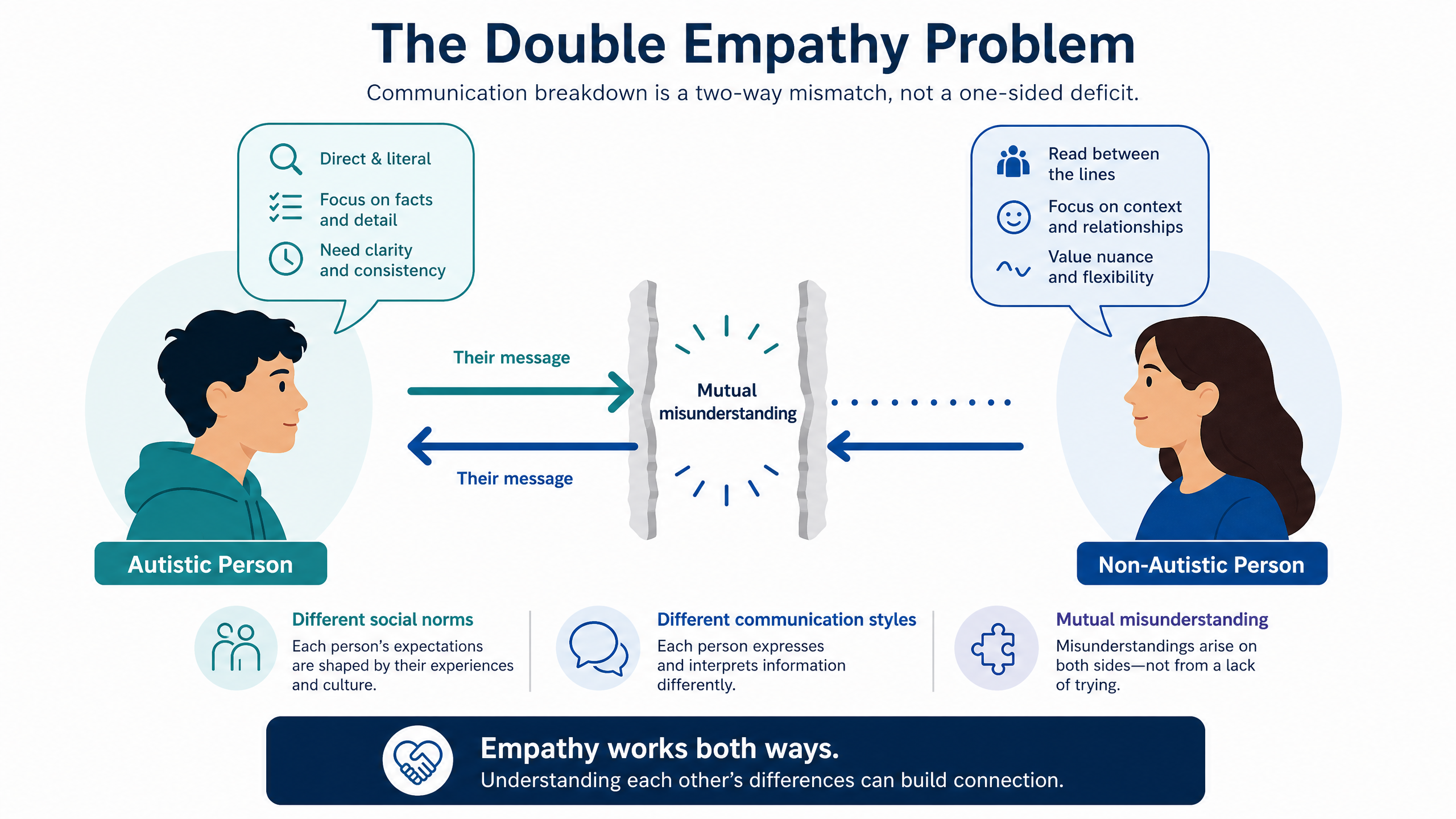 A diagram showing the double empathy problem: communication breakdown is a mutual mismatch, not a one-sided deficit.
The double empathy problem (or: it’s not just me)
In 2012, Damian Milton, an autistic autism researcher, introduced a concept called the double empathy problem. The idea challenges the long-held assumption that communication difficulties in neurodivergent people are a one-sided deficit. Instead, Milton proposed that misunderstandings between neurotypical and neurodivergent people are mutual. They arise not because one person is bad at communicating, but because people with different worldviews, sensory experiences, and communication styles struggle to interpret each other accurately.
This is an important distinction and it matters enormously in the context of career development.
When my review says “needs to communicate better,” the implicit assumption is that the communication breakdown is my fault. That I am the variable that needs adjusting. But Milton’s research, and a growing body of evidence supporting it, suggests something different: the breakdown happens between people, not within one person. Research by Crompton and others has found that autistic individuals often communicate smoothly and naturally with each other, building strong rapport and shared understanding. The friction shows up in mixed-neurotype interactions, where each person’s cues, pace, and interpretation differ.
Put another way: the problem isn’t that I can’t communicate. It’s that the system only recognises one communication style as valid, and it’s not mine.
I know this because I have a counter-example. I work in a team of four. Three ICs and a manager. Our communication would make a lot of people’s toes curl. It is fast, it is blunt, it is full of memes. It is also devastatingly effective. Our output has been so consistent and so fast that other teams, teams with no responsibility for or attachment to our work, have asked us to slow down. Our manager, who is genuinely exceptional and one of the rare managers I’ve had who creates space rather than policing it, sometimes has to remind us to pump the brakes so that marketing (who are also brilliant and supportive) can do their part before we’ve already shipped the next thing.
Let me say that differently so it lands. The same person who has been told to “communicate better” for years is also on a team that ships so effectively it has to be asked to slow down for the rest of the company to keep up. The communication isn’t the problem. It never was. The context determines whether my style is an asset or a liability, and the only variable that changes is who’s on the other side of the conversation.
I wrote about this recently on LinkedIn, in an article about Slack being your remote team’s social media. The argument there was about what happens when you police communication style in remote teams: the informal social layer dies, people become transactional, and the culture you thought you were protecting evaporates. The argument here is the same instinct applied to a different system. When you police communication style in career development, in reviews, in promotion criteria, you don’t get better communicators. You get people who mask harder, burn out faster, and eventually leave. Or worse, they stay. More on that later.
But the contrast matters. Inside my team, the communication works because nobody is asking anyone to translate themselves into a different cognitive register before they’re allowed to be heard. We are direct, we are fast, we are occasionally deeply stupid in the best possible way, and the work is excellent. That’s not despite the communication style. It’s because of it.
The friction shows up at the boundaries. When neurodivergent people like me interface with other parts of an organisation, the same directness that makes a team effective internally gets reframed as a problem externally.
It usually looks something like this. You bring substantive technical work into a cross-team conversation. Sometimes you weren’t even invited to the conversation in the first place, but you showed up because you had relevant expertise. The work is sound. The expertise is real. But the response isn’t engagement with the substance. It’s process critique dressed up as coaching. Why are you going to this person and not that person? How can you turn your opinion into something more objective? What’s actionable here for the team? The substance gets redirected into “how are you collaborating” territory, and the closing line is always some variant of “good observations, but lacking vision.”
Here’s the part that matters for the double empathy argument. Neurodivergent brains, particularly ones with ADHD and trauma in the mix, don’t always parse hostility the way neurotypical brains do. I’ve had exchanges where I thought we were joking until the tone crossed a line so explicit that even I couldn’t miss it. It’s not that I’m thick-skinned. It’s that my brain genuinely reads the interaction as banter. By the time I realise otherwise, the other person has often gone back and softened their own contributions, leaving only my reaction on the record.
I matched the energy. I didn’t exceed it. I kept it dry, kept it moving, got the work done. But I know how those interactions get recorded. It becomes another data point in the “needs to communicate better” column. The other person’s territorial gatekeeping, their tone, their unsolicited commentary on work that wasn’t theirs to review? That doesn’t make it into anyone’s performance review. The system isn’t built to see it. The system only sees the person who reacted, not the person who provoked. And when the provocation has been softened after the fact, there’s nothing left to point to even if someone bothered to look.
Out of curiosity once, I pasted an exchange like this into an AI assistant with no context, no framing, no prompt beyond the raw text. The AI’s unprompted analysis identified it as a textbook example of someone reframing substantive technical contributions as process failures. It noted that the response had redirected each of my points away from the substance and into collaboration territory, and that the closing tone was a particularly pointed way to dismiss individual initiative as a deficiency rather than a contribution.
I didn’t need an AI to tell me that. But there is something clarifying about watching a machine with no emotional investment, no office politics, no neurotype, read the same kind of interaction and arrive at the same conclusion I did. The pattern isn’t in my head. It’s in the system.
A 2025 article from Magara Law, applying the double empathy framework to employment law, asked a question that more HR departments need to sit with: “Are current workplace practices built to accommodate difference, or to normalise one way of communicating?” The answer, overwhelmingly, is the latter. And the career ladder? The career ladder is that normalisation made structural.
What we talk about when we talk about ladders
Career ladders are, in theory, a good idea. They provide transparency. They set expectations. They give people a framework for understanding what progression looks like and what they need to do to get there.
In practice, they are a rubric designed by neurotypical people, for neurotypical people, that has been branded as objective.
The Deloitte Insights report “A rising tide lifts all boats: Creating a better work environment for all by embracing neurodiversity” (yes, they used the same title, and yes, I’m stealing it so there) makes this point explicitly. The report found that growth and career path mean different things to different people, and that not everyone’s version of success maps to ascending a traditional hierarchy. It recommends that organisations should not predefine what success or growth should look like at all, and should instead build tailored career paths that recognise the goals, capabilities, and strengths of the individual.
That sounds lovely. I have never seen it happen.
What I have seen is that even the ladders that get a lot right tend to break at the same point every time. I’ve seen leveling guides that are outcome-oriented, that decouple progression from tenure, that measure technical depth and developer impact through genuinely fair metrics. Compared to generic corporate frameworks, these are thoughtful work. If you build good things and developers use them, those ladders see that.
But in most of them, there’s a dimension, usually called something like Influence, that becomes the career gate. And that’s where the whole thing quietly reverts to social performance metrics.
At entry levels, Influence requirements tend to be proportionate. Communicate proactively about blockers. Fine. Measurable.
One level up, and the bar starts to shift toward things like building consensus across functions, actively mentoring teammates, being recognised internally as a subject matter expert. A level above that, the bar shifts again, toward consensus across VPs and Directors, acting as an external spokesperson, setting narrative direction that other departments align to.
Every level of Influence escalates the requirement for neurotypical social navigation. Consensus-building, mentorship, stakeholder alignment, external presence. These are all valuable. Nobody is arguing they don’t matter. But they’re almost always described as behaviours, not outcomes. The ladder doesn’t say “ensure cross-functional alignment happens.” It says “build consensus.” Those are different things. A neurodivergent person might achieve alignment through documentation, through building something so good that adoption is organic, through a well-structured async proposal that doesn’t require reading the room in a meeting. But “builds consensus” implies meetings, relationship management, and political fluency. It implies a method, not a result.
The fix isn’t to remove Influence as a dimension. It matters. The fix is to rewrite it as outcomes. “Cross-functional teams have the context they need to act on your work” rather than “builds consensus across functions.” Let the method vary. Measure whether it worked.
What I have seen, beyond the specifics of any particular ladder, is a universal pattern. Rungs labelled “collaboration,” “communication,” “stakeholder alignment,” “executive presence,” and “cross-functional influence.” Every one of those rungs is a social performance metric. Every one of them favours a specific cognitive and interpersonal profile. And every one of them systematically disadvantages people whose brains process social information differently.
There’s another thing that happens with ladders that I think people need to see, because it’s subtle and it’s devastating and I don’t think most companies are even aware they’re doing it.
Sarah Drasner, who built her career ladder framework at Netlify and Google, open-sourced it at career-ladders.dev. It’s widely used as an industry benchmark for Developer Experience roles. Her framework has six IC levels: DX Engineer I, DX Engineer II, Senior, Staff, Principal, and Distinguished. At her Staff level, the expectations are things like: participates in cross-team collaboration where necessary, coordinates efforts across the team, works on API proposals alongside Product, notices recurring issues and creates resources to solve them. That’s team-to-org scope. Working alongside other teams, not above them.
Now compare that to what some companies put in their Staff expectations. Building consensus across VPs and Directors. Acting as a strategic lead and external spokesperson for the company. Setting narrative direction that Product Marketing, Sales, and Engineering all align to. Solving ecosystem-level problems that affect entire developer segments.
On Sarah Drasner’s framework, those expectations don’t appear until Principal or Distinguished. They are two full levels above where some companies slot them.
The effect is a hidden ceiling. The gap between Senior and Staff becomes so wide that it’s practically unjumpable, while Staff and Principal blur into each other because Staff has already eaten most of Principal’s scope. And the company gets something very convenient out of this arrangement: they can have someone performing Principal-level work while paying them and titling them as a Senior, because “Staff” has been defined so aggressively that nobody can quite reach it.
I don’t think this is always deliberate. Sometimes a ladder gets written by people who are themselves operating at a high level and they unconsciously set the bar at their own altitude. But the result is the same. If your Staff bar is an industry Principal bar wearing a Staff badge, and your Principal level is so thinly differentiated from Staff that nobody can articulate the difference, then you haven’t built a career ladder. You’ve built a moat.
And if someone was previously recognised as operating at Staff level, and the expectations have since been rewritten upward to include what the rest of the industry calls Principal, that person hasn’t stalled. The ladder moved underneath them. That’s not a development gap. That’s a structural betrayal dressed up as a framework.
Let me be concrete about what gets measured and what doesn’t.
Gets measured: whether I sent the Slack message that was too direct.
Doesn’t get measured: the work the Slack message was about.
The ladder sees the Slack message. The ladder does not see the 2am deploy.
The Gallup data, and the gap it reveals
In late 2025, Gallup published a report on neurodiversity in the workplace that contained a finding so quietly devastating I’m surprised it didn’t make more noise. Their research found that neurodivergent and neurotypical employees (or, normies) face largely similar workplace challenges and have largely similar strengths profiles. The CliftonStrengths distributions between the two groups are remarkably close.
But neurodivergent employees experience essentially all workplace challenges more acutely. Not because the challenges are harder for them, but because of a lack of acceptance or understanding in the workplace.
Read that again. The challenges are the same. The capabilities are the same. The experience is worse. The outcomes are worse. The promotions are fewer.
Some respondents in the Gallup study reported that their supervisors blamed their neurodivergence for challenges at work, denied its legitimacy, or publicly criticised their way of thinking. Some reported being denied promotions or being seen as inadequate by coworkers. There is a disconnect between what neurodivergent employees perform and how others see them.
There’s a subtler version of this that I think is worth naming, because it doesn’t look like discrimination. It looks like advice. It’s when someone in a position of authority over your career is also neurodivergent, and their way of relating to your experience is to tell you that they just learned to talk to people differently. That they worked a bit harder on those things. That it can be done.
And, look, good for them. Genuinely. If they found a way to adapt that works for their brain, that’s great. But neurodivergence is not one thing. No two people experience it the same way, and what works for one person can be completely unavailable to another. The implicit message underneath “I managed it, so can you” is that the system is fine and the problem is your effort. That’s not mentorship, it’s survivor bias. I’ve experienced both sides of this. One neurodivergent leader told me I’m doing really well and I should have had more support. Another told me they just learned how to deal with it with effort. Only one of those is useful. Only one of those recognises that the absence of support was a failure, not a character-building exercise.
A systematic literature review published in the Journal of Autism and Developmental Disorders in 2025 confirmed the structural nature of this problem. The study, which synthesised 56 studies from 12 countries covering nearly 5,000 neurodivergent employees, identified a consistent pattern: managers often attributed social challenges to personal factors rather than systemic ones, sometimes resulting in disciplinary actions or exclusion.
Personal factors. That’s the clinical way of saying: the problem is you.
Retention is not belonging
Here’s where I need to talk about the thing that nobody wants to hear.
Companies love to talk about retention as if it’s proof of a healthy culture. If people are staying, the thinking goes, we must be doing something right. High retention, low attrition, gold star.
But retention and belonging are not the same thing. And for neurodivergent employees, staying is frequently not a sign of satisfaction. It’s a sign of conditioning.
I know this because I have lived it. I have stayed in roles, in teams, in patterns, long past the point where the environment was sustainable. Not because I was happy. Not because I felt valued. Because I had been treated poorly or underrecognised for so long, across so many workplaces, that it felt normal. When you grow up neurodivergent in a world that was not built for you, you develop an extraordinarily high tolerance for being treated badly. You absorb it. You internalise the blame. You start to expect the feedback before it arrives, and you rehearse your face for receiving it. You nod. You say “thank you, I’ll work on that.” And you leave the room already knowing the next review will say the same thing.
And then you do work on it. And the next review says the same thing. And the one after that. Year after year.
The Deloitte report draws a useful distinction between tolerance, acceptance, and belonging. Tolerance and acceptance, the report argues, are not enough because they still place the “difference” before the “individual.” The majority determines the rules, and the neurodivergent person determines whether they can tolerate being tolerated.
Belonging is something else entirely. Belonging means you don’t have to earn the right to be there. Belonging means the system was designed with you in mind, not retrofitted after someone in HR went to a conference about neurodiversity.
Let me tell you what the opposite of belonging looks like.
At one company I’ve worked at, we once had a neurodivergent Employee Resource Group. It was lively. It was meaningful. People showed up because they needed each other, because finding other ND people in a workplace is like discovering you’re not the only person who speaks your language. It mattered.
That ERG has hollowed out. The neurodivergent colleagues who drove it have left. Not all at once. Slowly. One by one. The people who made the space vibrant moved on, and the company grew so fast that maybe nobody noticed. But I noticed. And the few of us who remain are too busy, too exhausted, too burned out from masking and performing and absorbing the same feedback year after year, to scream into the echo chamber any longer.
When your ND ERG shrinks while your headcount grows, that is not a participation problem. That is an exit interview the company never read.
The tickbox ladder
There’s a version of career laddering that is genuinely equitable. I’ve never worked somewhere that had it, but I can describe what it would look like: outcome-based, flexible in how those outcomes are achieved, transparent in its criteria, evaluated by people trained to recognise that cognitive diversity means different people will meet the same bar in different ways, and, crucially, consistent. The ladder doesn’t change mid-cycle. The ladder doesn’t get revealed at review time after the work has already been done against a different version. The goalposts don’t move every time a new manager inherits the team. If the rubric changes, the current cycle is evaluated against the rubric that was in place when the cycle began. Anything else isn’t a promotion framework, it’s a retrospective justification.
Then there’s the version that most companies actually have, which is a tickbox exercise dressed up as a development framework.
The tickbox ladder goes like this. We have defined a set of competencies. We have attached levels to those competencies. We have created a rubric. We review against the rubric twice a year. The rubric is the same for everyone, because fairness means treating everyone the same, right?
No. Equality means treating everyone the same. Equity means giving everyone what they need to reach the same outcome. And when your rubric is a list of behaviours that privilege neurotypical social performance, treating everyone the same is how you systematically exclude neurodivergent employees from progression while maintaining plausible deniability.
“We don’t discriminate. The process is the same for everyone.”
Yes. That’s the problem.
Research consistently shows that neurodivergent employees who are supported through inclusive structures thrive. The largest autism hiring programmes at SAP, JPMorgan Chase, Microsoft, and EY report retention rates exceeding 90%. JPMorgan Chase reported that their autistic employees achieved 48% to 140% more work than their neurotypical colleagues in certain roles. These aren’t marginal gains. These are transformational outcomes that happen when you stop asking people to climb trees and start asking them what they’re actually good at.
But those programmes are hiring initiatives. They get people through the door. What happens after that, when the ladder starts?
The Rollnik-Sadowska and Grabińska study from 2024 found that effective neurodiversity management in the workplace faces significant challenges, including limited career development opportunities and inadequate supervision quality, both of which impact the retention of neurodivergent employees. A systematic review from 2025 noted key gaps in understanding career development and job retention for neurodivergent employees. The academic literature confirms what neurodivergent workers have been saying for years: the ladder is where it falls apart.
What “communicate better” actually costs
I want to talk about what happens inside a person when they receive the same developmental feedback year after year.
Many neurodivergent brains experience what’s known as Rejection Sensitivity Dysphoria, or RSD. It’s not officially in the DSM, but it’s well-documented in clinical literature and recognised by leading ADHD researchers like Russell Barkley. RSD means that perceived rejection, criticism, or failure triggers an intense emotional response. Not a proportional one. An overwhelming one. The amygdala hijacks the process and the fight, flight, or freeze response takes over.
Layer on top of that a nervous system that is already primed for threat, and cognitive patterns that don’t let feedback land and sit. Instead, it loops. It replays. It spirals.
“Communicate better” is three syllables for the person writing the review. For the person receiving it, it is weeks.
And here’s the thing. Most neurodivergent employees know exactly where their sharp edges are. They know they can be impulsive. They know they can match energy when they should let it pass. They know their directness sometimes lands wrong. They have known it for years. They are actively, constantly, exhaustingly working on it. But the ladder doesn’t measure effort. It doesn’t measure progress.
This is why, in my user manual, I specifically say I value effort over effectiveness. Because I know what it’s like to spend a week spiralling on an issue, trying hard every single day, and still getting very little done. Neurodivergent brains do that. Neurodivergent employees who continue to deliver through weeks like that are demonstrating something the rubric isn’t designed to see: sustained commitment under conditions that would flatten most people. That isn’t a consolation prize. It’s evidence of exactly the kind of resilience and self-management that companies say they value, until it’s time to actually value it.
But most ladders don’t care about effort. They measure whether you’ve arrived at neurotypicality, and if you haven’t, you haven’t met the bar.
The bar, for many neurodivergent employees, isn’t performance. It’s personality.
Marlo Lyons, writing for additudemag.com, described her own experience of neurodivergent performance reviews. She received feedback like “over-driving” and was called “the Marlo show.” Her response captures something essential: “Hearing ‘over-driving’ didn’t tell me what to do differently; it told me who I am is wrong.” That’s the line that hits hardest for anyone who has ever received feedback about how they exist rather than about what they do.
That’s what “communicate better” means, in practice: You are wrong. Be less… Luke.
The boats with holes in them
The Federal Reserve Bank of Minneapolis published an article in 2021 titled “The myth of the rising tide.” In it, they examined JFK’s famous metaphor and found it wanting. “It has never been true,” they wrote, “that economic benefits are evenly distributed, yet the metaphor suggests that all boats float evenly on the same tide.” They pointed out that some boats lie outside the reach of the tide entirely.
I think about this in the context of workplace neurodiversity all the time. The tide is rising. Companies are growing. Headcount is up. Revenue is up. The all-hands deck is full of good news. And the neurodivergent ERG is down to a handful of people too tired to keep meeting.
James Peterson, a scholar quoted in discussions of the rising tide metaphor, put it this way (and I’m paraphrasing): the reality is that some people have leaking boats, and a rising tide doesn’t lift a leaking boat. If you want to lift all boats, you have to plug some of those holes.
The holes, in this metaphor, are the systems.
The holes are the career ladders that measure social performance as a proxy for professional capability. The holes are the feedback loops that pathologise neurodivergent communication instead of accommodating it. The holes are the ERGs that companies launch with fanfare and then starve of support. The holes are the review cycles where the same three words appear year after year and nobody thinks to ask: why isn’t this changing? Maybe it’s not the employee. Maybe it’s the framework.
Harvey Blume, writing in The Atlantic in 1998, said: “Neurodiversity may be every bit as crucial for the human race as biodiversity is for life in general. Who can say what form of wiring will be best at any given moment?”
He was talking about the species. But I think about it in terms of engineering. The best systems are the ones that handle edge cases gracefully. The worst systems are the ones that treat edge cases as errors. Career ladders that break neurodivergent employees aren’t encountering an edge case. They’re revealing a design flaw.
What equity actually looks like
Equity is not treating everyone the same. Equity is ensuring everyone has what they need to reach the same outcome.
In career development, that means:
Evaluating performance by outcomes, not behaviours. I don’t care how someone communicates with a difficult colleague. I care whether the project shipped. I care whether the SDK works. I care whether the customers are served. If the outcome is met, the method is secondary.
Training managers to recognise the double empathy problem. Communication breakdowns between neurotypical and neurodivergent employees are mutual. They are not the sole responsibility of the neurodivergent person to fix. When a review says “communicate better,” someone should be asking: communicate better according to whose standard?
Building career paths that don’t require climbing a tree. Not everyone wants to be a manager. Not everyone wants executive presence. Some people want to stay close to the work, build things, and be recognised for building things. The ladder should accommodate that without treating it as a lesser path.
Treating ERG attrition as a signal, not a footnote. If your neurodivergent ERG is shrinking while your company is growing, something is wrong. Don’t survey the people who left. They already told you. Listen to the people who are still there, barely, and ask them what they need.
Stopping the same feedback from appearing year after year without interrogation. If you’ve told someone to “communicate better” for years and nothing has changed, the intervention isn’t working. That is not a reflection of the employee’s unwillingness to grow. That is a reflection of the company’s inability to support them.
I once worked with a brilliant HR leader who made the entire organisation do training on giving actionable feedback. It was good training. It mattered. But leadership turns over, institutional memory gets lost, and the new cohort never does the training the previous one had. “Communicate better” is not actionable feedback. “Needs stronger collaboration” is not actionable feedback. They’re not even helpful. They’re just verdicts. If you want someone to change, you have to tell them what to do differently, specifically, and then support them while they try. Anything less is just documenting a problem you’ve decided not to solve.
The bit where I say something personal
I didn’t write this article because I want sympathy. I don’t. I wrote it because I want leadership teams to read it and recognise a pattern.
I’ve watched a lot of companies lose good neurodivergent colleagues. The kind who brought different perspectives, unconventional approaches, and genuine creativity to their work. The kind who needed the company to meet them halfway, and the company didn’t.
I am still here. But I want to be honest about why. Part of it is stubbornness. Part of it is that I genuinely love the work. And part of it is that I have been conditioned, through twenty years of being neurodivergent in workplaces that were not built for me, to accept what they believe I deserve and call it normal.
That’s not loyalty. That’s learned behaviour. And it’s not something companies should mistake for a sign that everything is fine.
FAQ
What is the double empathy problem?
The double empathy problem, introduced by Damian Milton in 2012, suggests that communication difficulties between neurotypical and neurodivergent people are mutual. It challenges the idea that autistic or neurodivergent people lack empathy or communication skills, proposing instead that both groups struggle to understand each other’s worldviews and communication styles.
How do career ladders exclude neurodivergent employees?
Career ladders often measure social performance metrics—like “building consensus” or “executive presence”—as proxies for impact. These rubrics privilege neurotypical communication styles and systematically disadvantage people whose brains process social information differently, even when their technical output and actual business impact are exceptional.
What does “masking” mean in the workplace?
Masking is the exhausting process of suppressing or camouflaging neurodivergent traits to fit into a neurotypical workplace culture. It is a high-cost survival strategy that leads to burnout, as neurodivergent professionals must perform two jobs simultaneously: their actual role, and the ongoing task of managing how they appear to others.